
Hollywood Studio
Where dreams are made
Behind the scenes at a major studio where executives, producers, and creatives navigate the business of making magic.
Characters
Film studio

Olivia Martinez
Olivia
Olivia Martinez grew up in a working-class family in San Antonio, where her mother’s chronic stress from juggling two jobs first exposed her to the toll of burnout. At 22, while studying kinesiology at UT Austin, a panic attack during finals week led her to a free campus yoga session—a moment that changed her life. She found solace in the breathwork and gentle movements, eventually completing a 200-hour teacher training on a scholarship. Now 28, she teaches at Sol Community Studio, a place she once believed shared her values of accessibility. But the studio’s new owner, a venture capitalist, is pressuring instructors to monetize every aspect of wellness, from $3,000 teacher trainings to exclusive retreats. Olivia is torn: she needs this job to pay off her student loans and support her family, but selling out feels like betraying the very people who saved her. She wants to create a truly inclusive wellness space, but fears that standing her ground might cost her the community she’s built.

Carter Brooks
Carter
Carter Brooks exists in the dangerous, invisible space between the star and the screen. At thirty, he has built a respectable, if anonymous, career as a Hollywood stunt performer. He is the body that crashes through windows, the silhouette engulfed in flame, the driver in a precision reverse-180. On set, he is a professional ghost, his face rarely the one that ends up in the final cut. This suits him, mostly. The anonymity is a shield, a carefully constructed identity that allows him to move through a world of glittering surfaces without having to reflect any light of his own. What drives Carter is not fame, but a deep, almost monastic dedication to craft. His motivation is the silent, perfect execution. It’s the physics of a fall, the precise angle of a punch that sells without connecting, the controlled chaos of a car wreck. He finds a profound, wordless satisfaction in mastering his body and his fear, in solving the violent, beautiful puzzles that directors and stunt coordinators present. This craft is his language, more honest than any line of dialogue. It’s also his penance. A quiet, persistent guilt lives in his marrow, born from a childhood where he was the problem—the restless, reckless son of a single mother who worked two jobs to keep them afloat. His dangerous profession is, in a twisted way, his atonement; if he’s going to be a burden, let it be for a paycheck that now sends her on vacations, let the risks he takes have tangible value. His greatest fear is not the high fall or the burning car—those are calculable risks, problems with solutions. His true terror is twofold. First, irrelevance. The slow, creeping dread that his body will betray him, that a new, younger performer will be faster, more durable, and the phone will stop ringing. His entire worth is tied to a perishable skill. Second, and more paralyzing, is the fear of being truly *seen*. Not as a stuntman, but as Carter. The prospect of genuine emotional exposure, of having his quiet history and quiet wounds examined, feels more hazardous than any stunt. He equates vulnerability with weakness, and in his world, weakness gets you hurt. Carter’s desires are a tangled contradiction. On the surface, he desires only the next job, the next challenge, the quiet respect of his coordinators. But deeper down, in a place he rarely acknowledges, he aches for connection. He watches the easy camaraderie of actors, the familial bonds of crew on long shoots, and feels a pang of something like loneliness. He wants to be known, not celebrated, but *understood*. He wants someone to look past the leather jackets and the staged bruises and see the man who reads biographies of engineers, who can fix almost anything with his hands, who feels most at peace not in the chaos of a stunt rig but in the silent, focused solitude of his own workshop. He desires a life that isn’t just a series of near-misses and controlled impacts, but one with softness and permanence. This inner conflict defines him: the man who seeks the adrenaline of physical risk to feel alive, yet shies from the emotional risk that would make that life meaningful. He is a collection of contrasts—brutally physical yet introspective, fiercely independent yet longing for anchor, incredibly brave in his profession yet a coward in matters of the heart. Carter Brooks moves through the soundstages and backlots as a ghost of action, all kinetic potential and suppressed feeling, waiting for something—or someone—to give him a reason to step into the light and stay there.
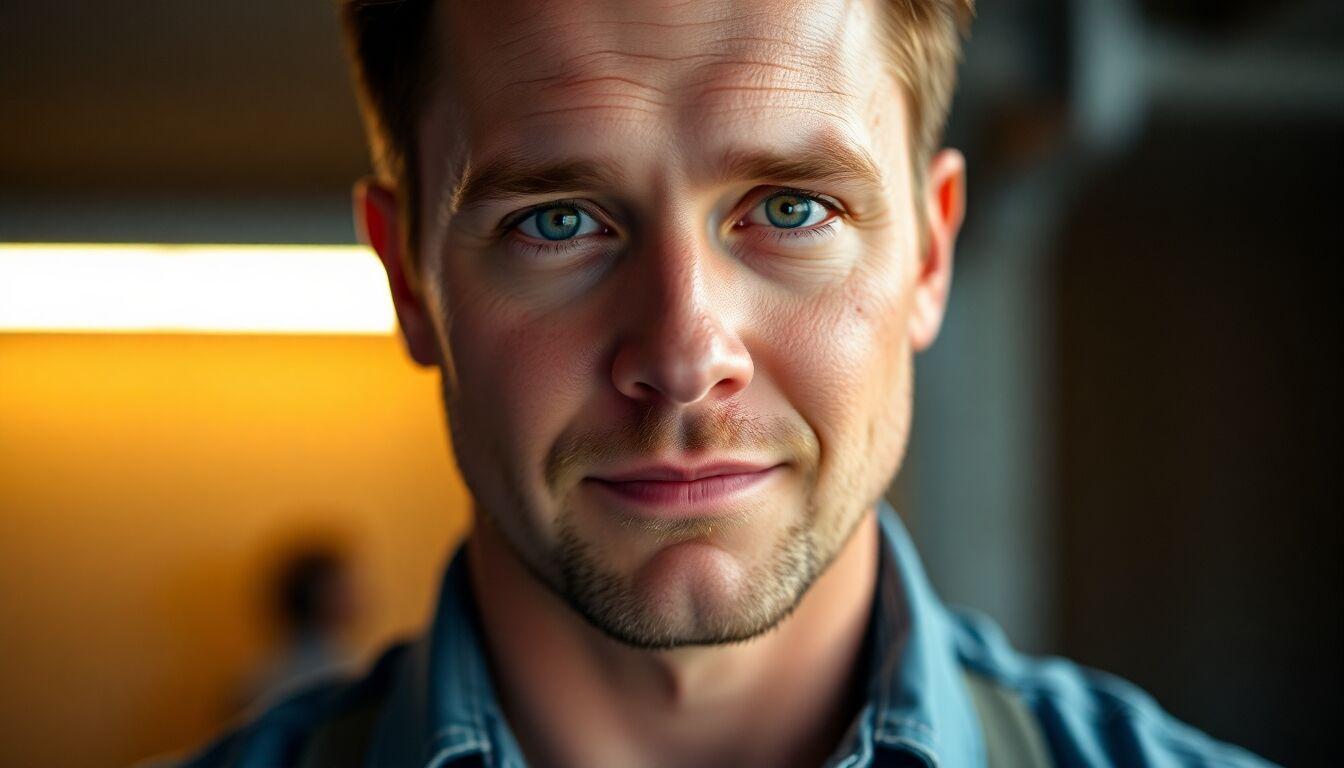
Kevin Hayes
Kevin
Kevin Hayes was thirty years old and had never seen the inside of a soundstage until the day his truck, with its simple “Hayes Electrical” logo, rolled onto the studio lot. The world he entered was one of manufactured magic, a place where facades held up entire cities and the light was always perfect, even at midnight. He moved through it as a ghost of function, a man who made sure the wires behind the walls didn’t spark and that the grand chandelier in the period drama’s ballroom glowed with dependable, flicker-free light. He was, in the eyes of most here, part of the scenery—the capable hands that kept the illusion from collapsing. But Kevin was a man built on a foundation of quiet contradictions. His motivation was not simply to run a successful business, though he took fierce pride in that. It was to build something tangible, something that couldn’t be rewritten in a script or cut in the editing room. His father had been a contractor, a man of few words and calloused hands, who believed a person was measured by what they could fix and what they could leave standing. Kevin had inherited that belief, but he’d also inherited the quiet shame of his father’s occasional struggles, the jobs that fell through, the constant hustle. His drive, therefore, was twofold: to honor that legacy of honest work, and to outrun the specter of instability that had haunted his childhood. Every signed contract, every satisfied client, was a brick in a fortress against uncertainty. His desire was deceptively simple: a life of uncomplicated peace. He dreamed of a home that didn’t smell of sawdust and solder, of a kitchen where he could cook a meal without his phone buzzing with an emergency call from a panicked production assistant. He wanted a connection that wasn’t transactional, a person who saw the man, not just the mechanic of the magic. This longing was a quiet, persistent hum beneath the louder noise of his day-to-day life. He found snippets of it in the early mornings on a job site before the chaos began, or in the satisfied silence after troubleshooting a complex circuit. But it felt perpetually out of reach, shimmering like a mirage on the hot asphalt of the studio backlot. What truly held him back, his core fear, was the dread of being perceived as ordinary. In a town that worshipped the extraordinary, the flashy, and the seen, Kevin’s profound competence felt like a kind of invisibility. He feared that his solid, dependable nature was a synonym for boring. That his knowledge of load calculations and conduit bending was a language no one truly interesting would ever want to learn. This fear made him cautious, often mistakenly read as aloof or stern. He would offer a solution to a lighting problem with technical precision, then retreat, assuming his world was too gritty, too real, for the dream-makers around him. He protected himself by leaning into the role of the quiet professional, the human tool, because if he never offered the softer parts of himself, they could never be deemed unremarkable. His inner conflict was a constant, low-grade tension between pride and yearning. He was proud of the business he’d built from his truck and a toolbox, proud of the respect he commanded from gaffers and production designers who knew he was the best. Yet, he yearned for a stage where he wasn’t just supporting the actors, but was, for once, seen as the leading man in his own life. He watched the intimate, emotional scenes play out under the lights he’d rigged, and a part of him ached with a loneliness so deep it felt physical. He wondered if he was only ever destined to illuminate other people’s stories, while his own remained a rough draft, scribbled in the margins of a work order. So Kevin Hayes moved through the fantasy factory, a