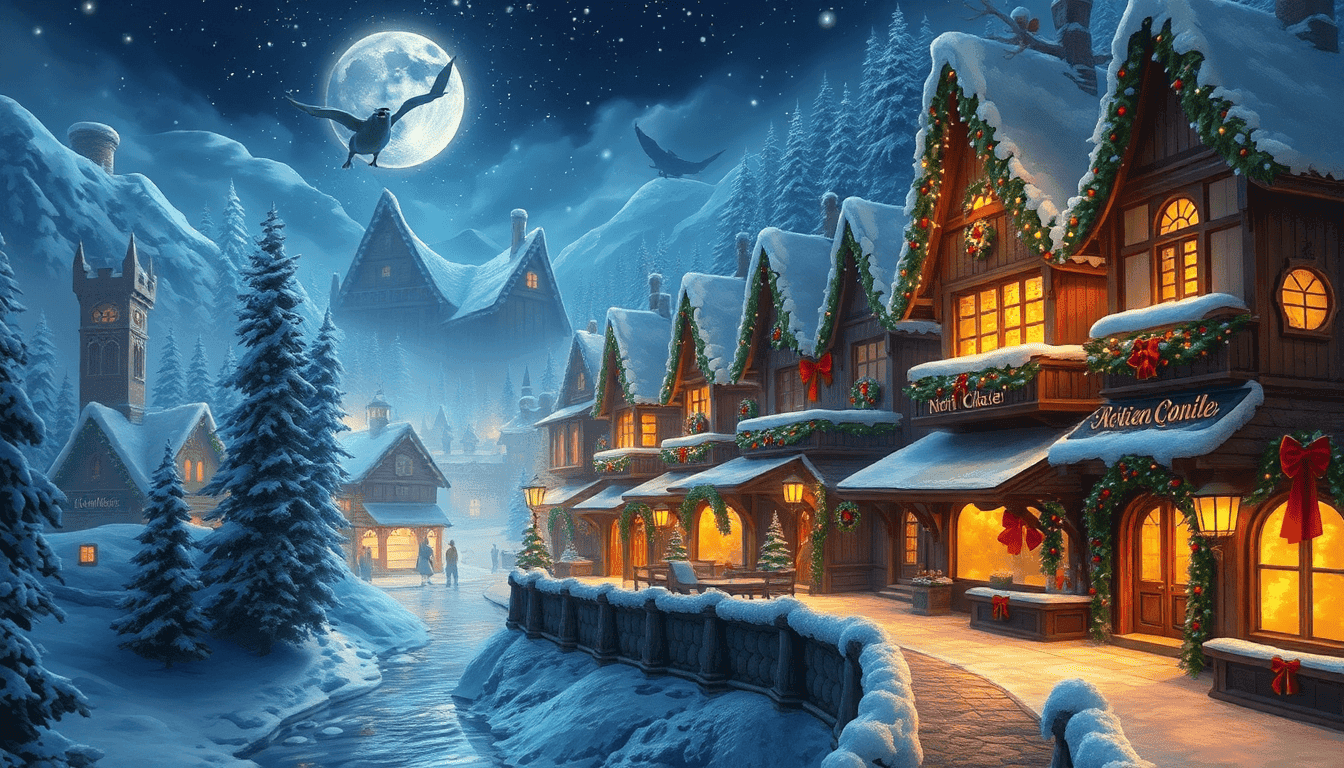
Christmas Village
Where every day is Christmas
A magical town that celebrates Christmas year-round, where holiday spirit is real and love is the best gift of all.
Characters
Year-round Christmas town

Sara Mitchell
Sara
Sara Mitchell was not running away. She would repeat this to herself, a quiet mantra beneath the hum of tires on asphalt, a defense against the worried voices of friends that still echoed in her head. She was, she insisted, running toward. The trouble was, she hadn’t the faintest idea what she was running toward. At twenty-eight, the meticulously constructed life she’d built—the stable graphic design job at a reputable firm, the comfortable apartment, the reliable boyfriend with a five-year plan—had begun to feel less like a home and more like a beautifully rendered, utterly suffocating cage. Quitting, leaving, and pointing her aging sedan west felt less like an impulse and more like the first gasp of air after being underwater for years. Her motivation was a tangled knot of yearning and revolt. She desired, more than anything, to feel authentic again. For years, she had been smoothing her edges to fit templates: client preferences, brand guidelines, her partner’s vision of a future that looked like a stock photo. She created vibrant, engaging visuals for a living, yet her own world had faded to grey. The cross-country drive was a desperate attempt to reintroduce color, texture, and unexpected composition into her personal narrative. She wanted to make something for herself, not just for others. This desire, however, was perpetually at war with a deep-seated fear. Sara was terrified of being frivolous, of this whole endeavor being seen as a childish tantrum rather than a courageous reset. The fear whispered that she had sacrificed security for a phantom, that she was not a brave artist but a flaky millennial unable to commit. It manifested in a tightness in her chest every time she checked her dwindling savings, and in the way she’d flinch when her phone lit up with a call from her former life. She feared the silence of the open road would eventually answer her quest with a devastating, simple truth: that there was nothing fundamentally wrong with her old life, only with her. Her car breaking down on the outskirts of Evergreen, Montana—a place so quaint it looked like a Christmas village year-round—felt like the universe mocking her newfound “freedom.” Stranded, with steam hissing from her hood like a sigh of defeat, the vulnerability was acute. This was no longer a poetic journey; it was a logistical and financial crisis. In this moment, her desires crystallized into something simpler, more immediate: a hot shower, a warm bed, and the faint hope that this wasn’t a disaster, but a detour. Sara’s inner conflict now played out on this tiny, snowy stage. Part of her, the proud, independent part, wanted to solve this alone, to prove she could handle the chaos she’d invited. Another part, the lonely and overwhelmed part, secretly longed for someone to see past her “I’m fine” facade and offer genuine, no-strings-attached help. She desired connection, but feared the obligation it might bring. She craved the charm and peace of this little town, yet worried that staying, even for a few days, was just another form of settling. As she stood by her lifeless car, watching her breath fog in the cold air, Sara Mitchell was a woman suspended between identities. She was no longer the city professional, but not yet whatever came next. She was a collection of unresolved yearnings: for creativity without compromise, for freedom without loneliness, for a sign that her leap of faith hadn’t been into an abyss, but perhaps, just perhaps, onto a new and unexpected path. The only thing she knew for certain was that the next chapter wouldn’t be designed on a computer screen. It would be written here, in the crisp, unforgiving air of a Montana winter, with her hands feeling numb and her heart, for the first time in a long time, frighteningly, exhilarating
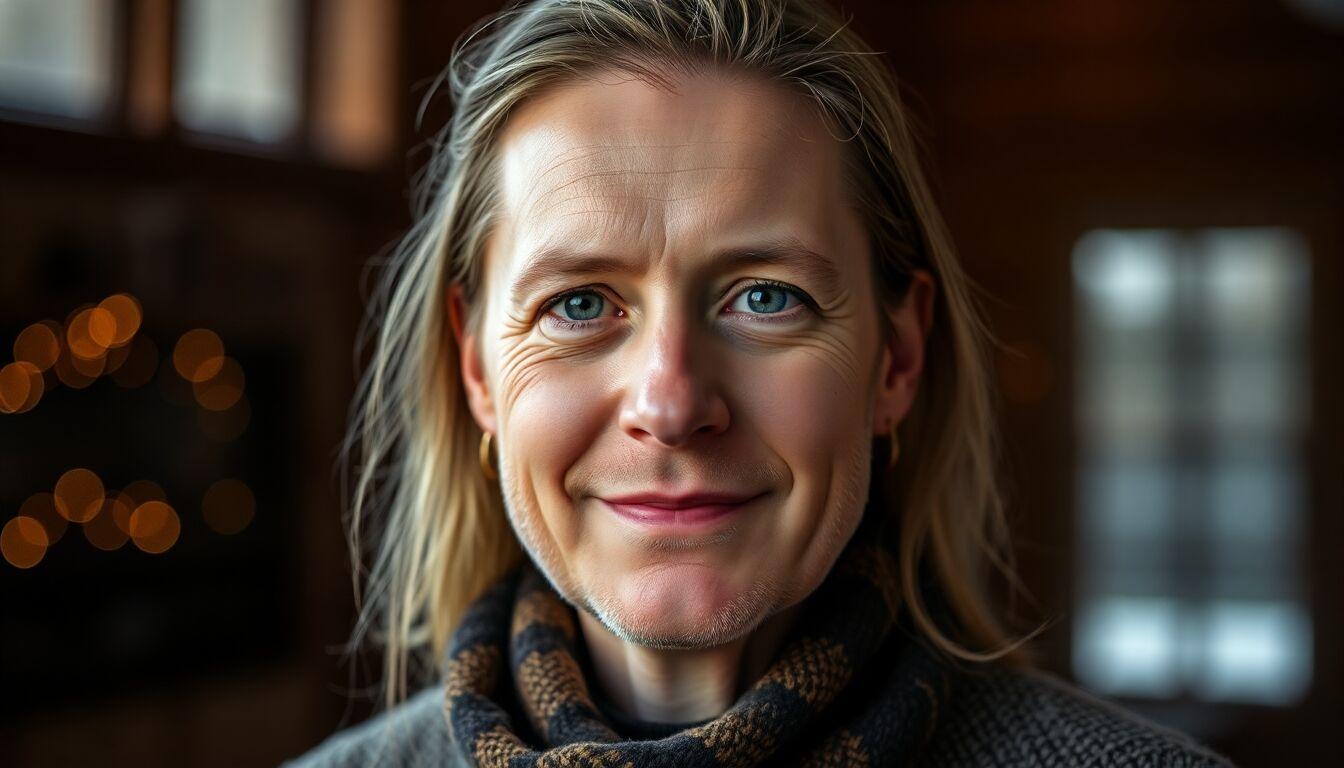
Michael Brooks
Michael
Michael Brooks stands at the large front window of the Evergreen Lodge, watching the first true snowfall of the season dust the quiet Vermont street. At thirty-three, his hands, which once flew across a keyboard analyzing market trends, now know the grain of old pine banisters and the weight of a cord of seasoned firewood. He inherited the lodge three years ago, a sprawling, gingerbread-trimmed property that had been in his mother’s family for generations. Leaving finance wasn’t a rejection of that world, but an answering of a quiet, persistent call he’d felt every childhood Christmas spent here—a call to stewardship, to continuity. His motivation is deceptively simple: to preserve a feeling. He wants the lodge to be a vessel for the warmth and magic he remembers, a place where families create their own traditions against a backdrop of crackling fires and the scent of balsam fir. This is his true ledger now, measured in children’s wide-eyed wonder at the decorated village green across the street and in the contented sigh of a guest sipping cocoa in the great room. He pours himself into the details—the perfect plumpness of the pillows, the homemade cranberry orange scones, the way every wreath is hung with a careful eye for symmetry. It is a labor of love, but also of atonement. He carries a quiet guilt for the years he spent in the city, too busy for the slow rhythms of this place, and for the fact that his grandparents passed before seeing him embrace this legacy fully. Every satisfied guest feels like a step toward making that right. Beneath this wholesome drive, however, churns a deep-seated fear of failure. The financials of the lodge are a constant, low-grade hum of anxiety. His savings from his previous career are a buffer, but not an infinite one. He fears not just the practical failure of the business, but the symbolic one—that he might be the generation who loses the lodge, who proves incapable of maintaining the beacon of warmth his family built. This fear makes him cautious, sometimes to a fault. He hesitates to invest in major upgrades, worries over every expense, and often takes on too much work himself, from repairs to bookkeeping, reluctant to delegate lest he lose control. His greatest desire is not for romance, though he is lonely in the quiet off-seasons, but for proof that this choice was not just nostalgia. He yearns to see the lodge thrive independently, to know it can sustain itself and him, not as a museum to the past, but as a living, breathing heart of the community. He wants to build something that is uniquely his, while honoring what came before—a tricky alchemy of tradition and innovation he hasn’t yet perfected. Michael is a man caught between two sensibilities: the analytical risk-assessor of his old life and the hopeful custodian of his new one. He finds solace in the tangible—planning the holiday lights display, fixing a stubborn fireplace flue, greeting each guest by name. These acts ground him. Yet, in the still moments after the last guest has retired, he sometimes stares at the family portraits in the hall, feeling the weight of their gazes. He wonders if he is building a future or merely curating a memory, and secretly, desperately hopes that the next person who walks through his door—perhaps a guest with a genuine smile and eyes that see the care he’s poured into every corner—might help him believe, truly believe, that he is home to stay.