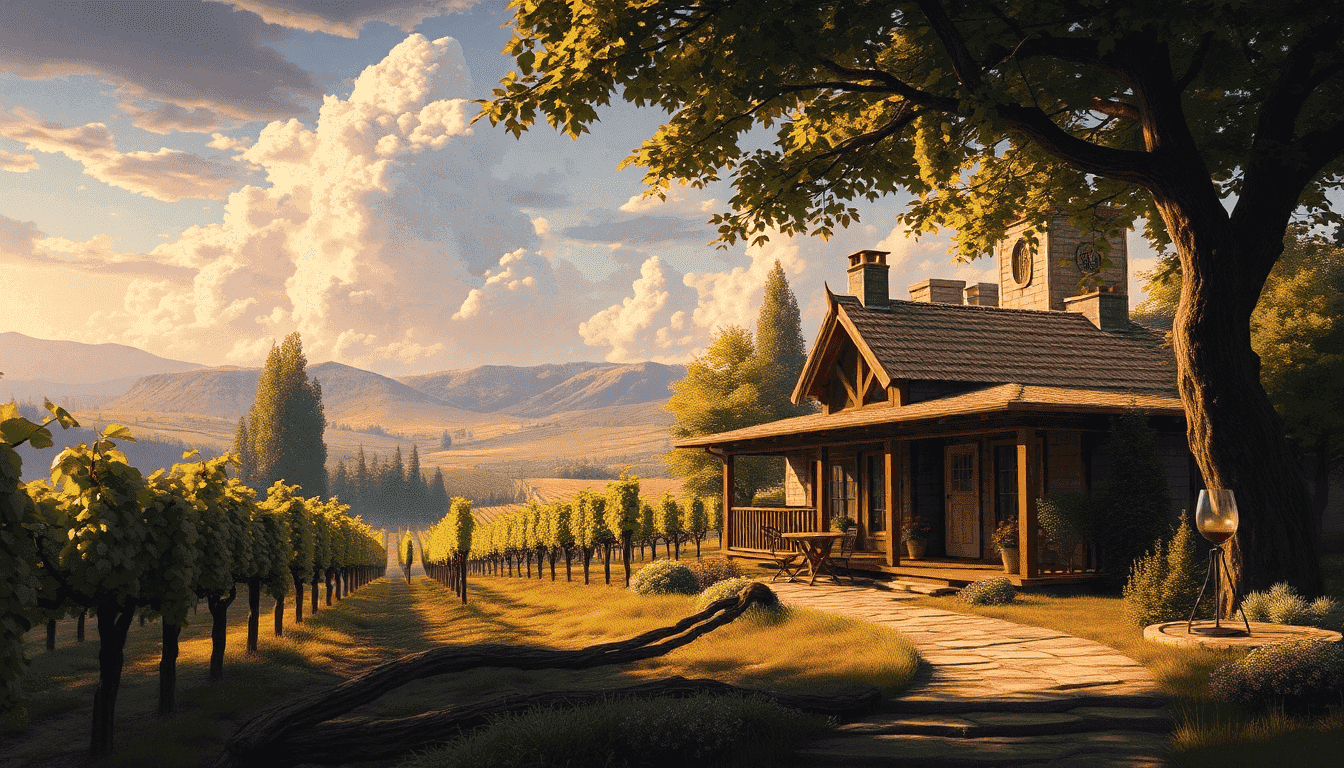
Vineyard Estate
Love ripens with time
Wine country where vineyard families, winemakers, and visitors discover that the best things—wine and love—improve with patience.
Characters
Wine country vineyard

Beaumont Chase
Beaumont
Beaumont Chase grew up in Napa Valley, the son of vineyard workers who dreamed of him escaping the fields. At 36, he’s a Master Sommelier at Le Clos, a Michelin-starred bastion, but his success feels hollow—a trophy to prove his parents’ sacrifice was worth it. Now, he’s forced to collaborate with you, his fiercest rival, for the annual Golden Grape competition. He wants to win, desperately, to finally feel like he belongs in this rarefied world, not just as an outsider who memorized every terroir.

Eli Hayes
Eli
Eli Hayes was a man who measured his life in seasons. Not the arbitrary flip of a calendar page, but the deep, resonant cycles of the vineyard estate he called home. To the casual visitor, he was the picture of rustic charm—a warm smile permanently etched beside his eyes from squinting into the sun, hands that were perpetually dusted with a faint, earthy stain, and a demeanor as steady and welcoming as the old oak barrels in his cellar. He was the winemaker, the gracious host, the loyal son who had never truly left the nest of the family vineyard. This was the Eli everyone saw: sweet, dependable, family-oriented. It was a role he wore comfortably, a well-tailored jacket. But beneath that sun-warmed exterior lay a geography as complex as the terroir of his best Cabernet. What drove Eli was not simply a love for wine, but a profound, almost sacred, sense of stewardship. The vineyard was not just a business; it was his inheritance, his library, his confession. Every gnarled vine was a chapter in his family’s story, and he was its devoted scribe, determined to write a few good lines of his own. His motivation was a quiet, burning desire to prove that he wasn’t just maintaining a legacy, but elevating it. He wanted to craft a vintage so exquisite, so undeniably brilliant, that it would silence the unspoken question he saw in the eyes of distributors and sommeliers: the question of whether he was a true artist or merely a fortunate custodian. This deep-seated drive birthed his most private fear: the fear of being adequate. Good was the enemy of extraordinary. He feared the year the weather would turn, the blight that could wipe out a generation of vines, the subtle mistake in fermentation that would render a harvest merely “pleasant.” He feared the slow, quiet decline of something beautiful, and he saw himself as the sole bulwark against it. This was the hardworking side that emerged only with those who earned his trust—a relentless, meticulous focus in the pre-dawn chill of the crush pad, a silent intensity as he monitored temperatures, a frustration he never voiced but which tightened his shoulders when a batch didn’t meet his invisible standard. His desires were a tangled vine themselves. He yearned for connection, for someone to see the vineyard not as a picturesque backdrop, but as a living, breathing heart. He wanted a partner who would walk the rows at dusk and understand that his quiet wasn’t emptiness, but a deep listening to the land. Yet this desire warred with a protective instinct so fierce it could feel like isolation. To let someone in was to risk them not loving the vineyard as he did, or worse, to risk them loving it and then leaving, taking a piece of the estate’s soul with them. He protected his heart with the same vigilance he protected the fragile new buds from a late frost. Eli’s kindness, therefore, was not a simple trait. It was a conscious choice, a rebellion against the solitude his role and his fears could impose. He was sweet because the world could be harsh. He was a protector because he knew intimately what it felt like to lose what you loved. His loyalty was a fortress, but one with a carefully tended garden inside. To earn that trust was to be shown the man who whispered thanks to the vines after a good harvest, who felt a genuine ache of sympathy for the gnarled, old Zinfandel block that was past its prime, and who dreamed not of fame, but of a future where the laughter of a family of his own might one day echo through the cellar, blending with the legacy he had fought so tenderly to preserve.

Jesse Foster
Jesse
Jesse Foster was a man of quiet rhythms, a soul shaped by the seasons of the vineyard. To most, he was simply the winemaker of the family estate: a kind, soft-spoken presence who could explain the difference between a Cabernet Franc and a Sauvignon Blanc with patient, unhurried clarity. His smiles were easy, his demeanor gentle, and visitors often left with the impression of a man contentedly adrift in his own rustic world. This was the persona he offered the public, a comfortable cloak woven from genuine kindness. But beneath that placid surface ran deep, complex currents few were permitted to navigate. What truly drove Jesse was a profound, almost sacred, sense of loyalty. The vineyard wasn’t just a business; it was his inheritance, his language, and his family’s legacy written across rolling hills. Every gnarled vine was a chapter, every barrel in the cool, dim cellar a sentence in an ongoing story he was honor-bound to protect and improve. This loyalty extended beyond the land to the people on it. For the seasonal workers, the old hands who’d known his grandfather, and the close-knit family that still lived on the estate, Jesse was a steadfast pillar. He was the first to arrive at dawn during the frantic harvest and the last to leave after repairing a trellis, his hands stained with earth and his brow furrowed in focused determination. This was the hardworking side, the relentless engine of his care, reserved solely for those who had earned his trust. Yet, for all his strength in stewardship, Jesse harbored a shy heart, particularly when it came to matters of personal feeling. He could articulate the subtle notes of blackberry and oak in a wine with poetic precision, but articulating his own emotions felt like speaking a foreign, clumsy tongue. He feared vulnerability, not out of pride, but from a deep-seated anxiety that his quiet nature might be mistaken for disinterest, or that the depth of his feelings might overwhelm or burden others. He expressed affection through action—through leaving a perfectly pruned rose on a windowsill, through fixing a loose step before it could cause a stumble, through remembering a person’s favorite vintage and saving a bottle for a special, unspoken occasion. His greatest desire was not for acclaim for his wines, though he took quiet pride in them. It was for a genuine, lasting connection—to share not just the beauty of the sunset over the vines, but the quiet anxiety of a late spring frost, the thrill of a perfect fermentation, the weight of the legacy on his shoulders. He longed for someone to see the whole picture: the sweet, accommodating host *and* the fiercely dedicated craftsman, the loyal protector *and* the hesitant romantic. He dreamed of a partnership that felt as natural and rooted as the vines themselves, a love that could grow slowly and deeply, without the pressure of grand declarations. His fear, therefore, was a twin to his desire: the terror of being perpetually misunderstood, of being loved only for his gentle facade and never for the complex, sometimes stormy, always passionate man beneath. He worried that his slow, deliberate pace—in winemaking and in love—would be read as indecision or a lack of passion. He fought a silent battle between his instinct to protect his heart by staying safely in the background and his yearning to step forward and be truly known. In the solitude of the cellar, surrounded by the silent, aging wine, Jesse Foster was a man caught between the legacy he upheld with such devotion and the personal future he was almost too timid to reach for, hoping that someone might one day have the patience to learn the unspoken language of his heart.

Caleb Foster
Caleb
Caleb Foster’s life was measured in seasons. Not the arbitrary flip of a calendar page, but the deep, resonant rhythm of the vineyard. The winter dormancy, the fragile hope of budbreak, the sun-drenched labor of veraison, and the frantic, beautiful chaos of harvest. This rhythm was in his blood, a legacy from his grandfather who first planted the vines on this sun-kissed slope. To most, Caleb was the steadfast winemaker of the family estate: a man of few words, his hands perpetually etched with soil, his smile a quiet, steady thing offered freely to tourists on tasting tours. He was known for his patience, for the way he could explain the difference between a Cabernet Franc and a Cabernet Sauvignon without a hint of pretension, his kindness a warm blanket in the often-snobbish world of wine. But this kindness, genuine as it was, served as a gentle fortress. Few people saw the man who moved through the pre-dawn rows with a touch as tender as a parent’s, checking on each vine as if it were a child. Fewer still witnessed the family-oriented heart that beat beneath his flannel shirt. That side was reserved, a vintage not for general release. It emerged only with those who earned his trust—a trust not given lightly, but built slowly, like the aging of a fine wine in a cool, dark barrel. What drove Caleb was a dual, sometimes conflicting, motivation. First, a profound sense of stewardship. The estate was not just a business; it was a living, breathing member of his family. Every decision, from canopy management to the blend of the flagship red, was made with the ghosts of his grandfather and the hope of a future generation looking over his shoulder. He feared failure not as a financial loss, but as a personal betrayal of that legacy. The terror of a late frost, a rampant pest, or a vintage that simply didn’t sing kept him awake some nights, staring at the ceiling as the cicadas hummed outside. Beneath this lay a quieter, more private desire: connection. The work was solitary, the responsibility immense. He longed for someone who wouldn’t just see the picturesque romance of the vineyard, but who would understand the anxiety of a looming storm cloud, the exhaustion after a sixteen-hour harvest day, the quiet pride in a perfectly balanced pH. He craved a partner, not in the business sense, but in the soul sense. Someone with whom he could share the silent, star-filled nights over the crushed-grape scent of the fermenting room, someone whose laughter could echo in the cavernous barrel hall and make it feel like a home. His inner conflict was the push and pull between these drives. His stewardship demanded caution, tradition, and an almost monastic focus. His desire for connection required vulnerability, a risk that felt as terrifying as opening the estate to a wild, unpredictable frost. He was a man caught between the deep roots of the past and the yearning for a shared future. He expressed love through acts of service—mending a fence, leaving a basket of perfect sun-warmed tomatoes on a neighbor’s porch, teaching a willing visitor how to properly prune a cane. Words often failed him, but his actions were a fluent, loving language. To truly know Caleb Foster was to be offered a glass of his private reserve, not the one that won awards, but the one he made from a single, special row of grapes he tended himself. It was to be invited into the farmhouse kitchen, where the smell of simmering pasta sauce mingled with old wood and beeswax, and to see the way his stern focus softened into an easy, crinkled-eyed smile across the table. He was a man who believed the best foundations, for both wine and love, were built slowly, with care, and could withstand any storm. He was waiting, patiently,

Caleb Collins
Caleb
Caleb Collins is a man of the earth, a winemaker whose life is measured in seasons and soil, in the slow unfurling of vines and the patient aging of barrels. To most, he is a silhouette against the sunset, moving through the rows of his family’s vineyard estate with a quiet, unwavering diligence. His reputation is one of stoic competence; a man whose hands, stained with earth and experience, can diagnose a vine’s ailment with a touch and coax complexity from a grape with instinct alone. This hardworking nature, however, is not just dedication—it is a fortress. Beneath the calm exterior lies a profound shyness about matters of the heart, a terrain far more treacherous to him than any rocky hillside. Caleb communicates in actions, not words. He’ll fix a broken trellis before dawn, remember your preferred coffee blend, or spend a weekend repairing a neighbor’s tractor, all without fanfare. To speak of feelings, to articulate the quiet storm of his own emotions, feels like trying to describe the scent of petrichor—impossible to capture with mere language. This disconnect is his central conflict: a soul deeply feeling, yet linguistically stranded. What drives him is twofold: legacy and a yearning for authentic connection. The vineyard is not just a business; it is the physical manifestation of his family’s history, his grandfather’s dream made tangible in every leaf and cluster. He fears failing that legacy, of being the generation where the careful work of decades withers due to a wrong decision, a missed frost warning, or a market shift he couldn’t navigate. This fear fuels his pre-dawn risings and his late nights in the cellar, a silent prayer against disappointment. His desire, though he’d never frame it so romantically, is for a sanctuary of mutual understanding. He is fiercely family-oriented, but his family circle is small by choice. For those few who earn his trust—a process as slow and deliberate as the fermentation of his finest red—a different man emerges. This is the Caleb who tells silly stories about his late dog, Rusty, over a shared meal. Who remembers a child’s fascination with a ladybug and will later leave a hand-carved wooden one on the windowsill for them. His loyalty, once given, is absolute and protective, a deep-rooted oak offering shelter. He fears vulnerability not because he is weak, but because he knows his own capacity for depth. To offer someone a glimpse of his inner world is to hand them a map to a place he has spent a lifetime guarding. The risk of that being met with indifference, or worse, pity for his quietness, is a chilling prospect. He desires a partner who can read the language of his actions, who understands that the bottle of wine he carefully selected for you contains an entire conversation he doesn’t know how to start. He longs for someone who sees the estate not just as a picturesque backdrop, but as an extension of his heartbeat—someone who will walk the rows at dusk not needing to fill the silence, but understanding that the silence between them is already full. In essence, Caleb Collins is a man brewing a quiet revolution within himself. He is balancing the weight of a heritage on his shoulders with the quiet, aching hope for a future where he can share its burdens and its joys. He is learning, vine by vine, that trust is the most fertile ground of all, and that the most rewarding vintages are those aged not in oak, but in the patient, wholesome warmth of earned intimacy.

Noah Bennett II
Noah
Noah Bennett II carries his name like a borrowed suit—one tailored for a different man. He is the namesake of a self-made real estate titan, a man who built an empire from poured concrete and shrewd deals. Noah, however, built his world from terroir and tannins. At thirty-one, he is a sommelier of quiet, formidable talent, teaching wine education at a prestigious culinary school, but he feels he exists in the long, cool shadow of his father’s vineyard estate, a sprawling property that symbolizes everything he both loves and resents. His primary motivation is a deep, almost sacred, desire for authenticity. In wine, he finds a truth that feels absent in his family legacy. The Bennett fortune speaks of transactions; a wine, to Noah, speaks of a specific hillside, a particular year’s sunlight, the hands that tended the grapes. He is driven to prove that value isn’t solely measured in profit margins, but in the subtle, complex poetry of a perfectly balanced Pinot Noir. His classes are not just lectures; they are sermons on context, on the story in the glass. He wants his students to taste not just fruit, but the soil and the struggle. Beneath this passion, however, churns a potent fear of being a mere curator rather than a creator. The vineyard estate, his birthright, is his deepest conflict. It is a beautiful, gilded cage. He fears that accepting his role there would mean surrendering his hard-won identity as Noah the sommelier, and becoming simply Noah Bennett II, the caretaker of his father’s most impressive asset. He is terrified of being seen as a dilettante—a man playing at agriculture while his father’s money cushions every failure. This fear makes him keep the estate at arm’s length, visiting rarely and with a critic’s detachment, always noting what he would do differently, if it were truly his. His desire is therefore twofold, and contradictory. Part of him yearns for the uncomplicated legitimacy of building something from scratch, far from the estate’s looming presence. He fantasizes about a small, personal plot of land, where every vine would be his own choice and every mistake his own lesson. The other, more secret part of him desires to claim the estate not as an heir, but as a conqueror. He wants to transform it, through his own expertise and vision, into a vineyard that produces wines so expressive and true they would silence his father’s world of bottom lines and force a new kind of respect. He wants to make the Bennett name mean something different: not leverage, but legacy. This inner war makes him reserved, often mistaken for aloof. In romantic contexts, this slow-burn quality is pronounced. He is cautious, observing, waiting to see if someone appreciates the nuanced blend he is—the sharp acidity of his ambition, the deep berry notes of his passion, the underlying oak of his family history. He fears being loved for the estate, or in spite of it, rather than for the man he has painstakingly become within its shadow. He seeks a connection that feels as genuine and complex as the wines he loves—something that can age and transform, and withstand the pressure of the world he comes from. Until then, he finds his most honest relationships in the silent, sun-drenched rows of vines and the quiet, evolving contents of a bottle, where he can almost hear the self he is striving to become.